
Blister Packs vs. Pill Organizers: Which Is Right for Your Parent?
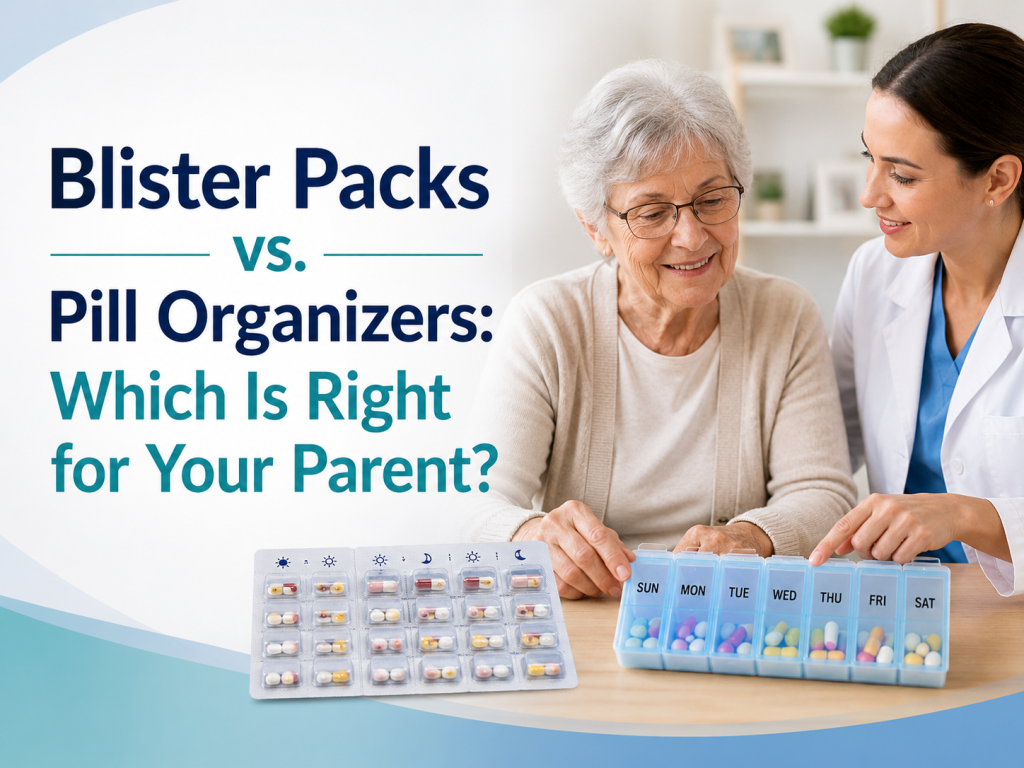
When an aging parent moves from one prescription to five or six, the kitchen counter starts to look like a small pharmacy. Sorting tablets by hand becomes a daily source of stress for adult children trying to manage medication schedules from a distance, and a missed or doubled dose is rarely obvious until something goes wrong. Two systems dominate the conversation around medication management for seniors: the pharmacist-prepared blister pack and the self-filled pill organizer. Both solve the same problem in different ways, and the right choice depends on your parent’s memory, dexterity, and daily routine rather than on which option sounds more modern. Key Takeaways What Is a Blister Pack? A blister pack — also called compliance packaging or a bubble pack in pharmacy practice — is a sealed medication card prepared directly by a pharmacist. Each pocket holds a single dose, labeled with the exact date and time it should be taken, such as Tuesday morning or Friday bedtime. The patient simply peels back the correct pocket rather than counting pills from separate bottles. Preparing a blister pack involves the pharmacist reviewing every active prescription, checking for interactions, and consolidating tablets and capsules into one continuous strip covering one to four weeks. Over-the-counter medications, vitamins, and supplements can usually be included in the same card once a pharmacist has confirmed they are safe to combine with existing prescriptions. This system removes the guesswork of manual sorting, which is precisely why it is recommended so often for parents with several prescribers, a recent hospital discharge, or early signs of forgetfulness. Because a licensed professional fills every pocket, the margin for human error drops substantially compared with a system a family member assembles at the kitchen table. What Is a Pill Organizer? A pill organizer is a reusable plastic container divided into compartments, most commonly one row for each day of the week and sometimes additional columns for morning, noon, evening, and bedtime doses. Unlike a blister pack, nobody seals it — a family member, caregiver, or the parent themselves fills each compartment directly from the original prescription bottles. Organizers range from simple seven-day boxes to elaborate systems with multiple daily compartments, locking lids, and alarms that beep when a dose is due. Some models use large, high-contrast labels for parents with low vision, while others are compact enough to slip into a handbag for a weekend trip or a doctor’s appointment. The appeal of a pill organizer lies in its flexibility and low cost. It is purchased once, reused indefinitely, and can be refilled the moment a prescription changes without waiting on a pharmacy turnaround. That same flexibility, however, places the entire burden of accuracy on whoever fills it each week. Blister Packs vs. Pill Organizers: Key Differences Safety is usually the deciding factor for families comparing these two systems. Because a pharmacist checks and seals every dose in a blister pack, the risk of a missed tablet, double dose, or mixed-up medication drops considerably. A pill organizer depends entirely on the person filling it staying alert every single week, which becomes harder to guarantee as caregiving fatigue sets in. Convenience runs in the opposite direction for each option. A pill organizer can be adjusted instantly the moment a doctor changes a dosage, while a blister pack usually requires the pharmacy to reprint the current cycle, which may take a day or two depending on the pharmacy’s workflow. Families juggling frequent medication changes sometimes find this turnaround frustrating during an already stressful period. Cost and caregiver time round out the comparison. Many pharmacies across Etobicoke and the wider Toronto area prepare compliance packaging at no additional charge as part of routine dispensing, though policies vary and are worth confirming directly. A pill organizer requires only a one-time purchase but demands a recurring weekly commitment from a caregiver, which adds up as medications multiply. Factor Blister Pack Pill Organizer Who fills it Pharmacist Patient or family caregiver Dosing error risk Lower — pharmacist-verified Higher — depends on manual filling Typical cost Often included with dispensing service One-time purchase, reusable Flexibility for dose changes Slower — needs pharmacy reprint Immediate Best suited for Multiple medications, memory concerns Independent, organized patients Portability Slim, travel-friendly Bulkier but reusable How to Choose the Right Option for Your Parent Start with memory and cognitive ability, since this factor influences safety more than any other. A parent showing early signs of forgetfulness, confusion, or a dementia diagnosis benefits from the built-in verification of a blister pack, where a wrong dose is far less likely to slip through unnoticed by both the patient and a distant caregiver. Medication count matters just as much. A parent managing polypharmacy — generally defined in clinical practice as taking five or more medications regularly — faces a meaningfully higher risk of dosing mistakes than someone on one or two prescriptions. At that level of complexity, pharmacist-prepared packaging removes a substantial amount of daily decision-making from an already overloaded routine. Dexterity, lifestyle, and caregiver capacity deserve equal weight in the decision. A parent with arthritis may struggle to snap open small organizer compartments, while a blister pack’s peel-back pockets are often easier to manage one at a time. A family member juggling work and long-distance caregiving may also find a pharmacist-filled system more sustainable than committing to a precise weekly sorting routine. Conclusion Neither system is universally better — each serves a different caregiving reality. A blister pack shifts responsibility to a pharmacist and suits parents managing multiple medications, memory changes, or a busy caregiver’s schedule, while a pill organizer suits an independent parent who wants direct control over a simpler routine. The safest choice is the one your parent will use correctly every day, not the one that looks the most sophisticated. If you are still weighing the two, a conversation with a pharmacist is the most reliable next step. A pharmacist can review your parent’s full medication list and recommend whether a blister pack or a pill organizer fits