
Acne Breakouts? Skip the Dermatologist Wait – Your Pharmacist Can Help
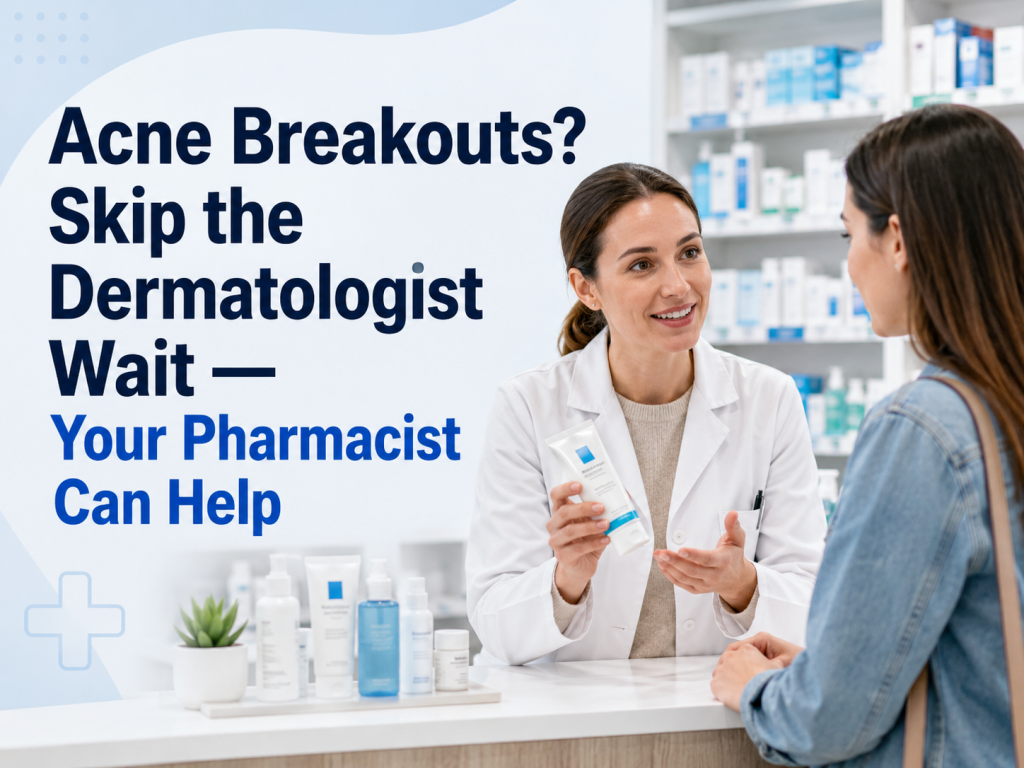
A breakout rarely waits for a convenient time, and neither does a dermatology referral. In Ontario, non-urgent dermatology referrals — the category most acne cases fall into — commonly take four to five months to result in an appointment, and can run even longer in some regions. For most people, that gap between noticing a flare-up and getting real treatment is where frustration sets in. Acne is also one of the most common reasons for a dermatology referral in the first place, which means a scarce specialist resource is being used for a condition that, in its milder forms, does not require a specialist at all. Ontario’s expanded pharmacist prescribing rules exist precisely to close that gap for conditions exactly like this one. Key Takeaways What Causes Acne Breakouts? Acne develops within the pilosebaceous unit, a structure formed by a hair follicle and its attached sebaceous gland. During puberty and at other points of hormonal fluctuation, rising androgen levels push these glands to overproduce sebum, the oily substance that normally keeps skin lubricated. When sebum production outpaces what the skin can shed, the stage is set for a breakout. Excess sebum combines with dead skin cells to plug the follicle opening, forming what dermatologists call a comedone. A closed comedone, trapped beneath the skin, appears as a whitehead, while an open comedone that reaches the surface oxidizes into the familiar dark plug of a blackhead. Neither is infected on its own — they are simply blocked pores. Inflammatory acne develops when Cutibacterium acnes, a bacterium naturally present on skin, multiplies inside a blocked follicle and triggers an immune response, producing the red, tender papules and pustules most people associate with a flare-up. Stress, certain cosmetics, friction from helmets or masks, and some medications can all aggravate breakouts, though hormonal activity remains the primary driver. How a Pharmacist in Etobicoke Can Help With Acne Since Ontario expanded pharmacists’ prescribing authority, a pharmacist in Etobicoke can now assess mild acne in person and prescribe treatment on the same visit, without waiting for a physician referral first. This falls under the province’s Minor Ailments program, which authorizes pharmacists to manage a defined list of common conditions — mild acne included — under Ontario Regulation 256/24 of the Pharmacy Act, 1991. For comedonal and mild inflammatory acne, a pharmacist can prescribe topical treatments such as adapalene, a retinoid that helps unclog follicles, azelaic acid, which calms inflammation and limits bacterial growth, or benzoyl peroxide. Before prescribing anything, the pharmacist reviews your skin history, current medications, and any pregnancy considerations to select the safest, most appropriate option for your situation. The consultation itself costs nothing for anyone with a valid OHIP card, and many pharmacies can see you the same day without a scheduled appointment. Once treatment begins, your pharmacist typically notifies your family doctor to keep your medical record complete, so this option adds convenience without removing you from your existing circle of care. Pharmacist Care vs. Dermatologist Referral: Knowing the Difference Pharmacist-led care is well suited to mild acne — a handful of blackheads, whiteheads, or small inflamed bumps concentrated mainly on the face, without deep cysts or visible scarring. If topical treatment from a pharmacist brings the breakout under control within a reasonable trial period, typically eight to twelve weeks, no further referral is usually necessary at all. Moderate to severe acne — deep, painful nodules or cysts, widespread scarring, or breakouts covering the chest and back — falls outside a pharmacist’s prescribing scope and warrants a dermatologist referral. The same applies to acne that fails to improve after a full pharmacist-guided treatment trial, or that appears suddenly alongside other symptoms suggesting a hormonal condition such as polycystic ovary syndrome. This is exactly where a pharmacist’s assessment adds value even beyond prescribing: identifying which breakouts genuinely need specialist attention and which can be resolved without one. That triage step alone can save weeks of waiting, since patients arrive at a dermatology appointment, if still needed, with a documented treatment history already in hand. Factor Pharmacist Dermatologist Acne severity treated Mild (comedonal, limited inflammatory) Moderate to severe, cystic, or scarring Typical wait time Often same day Commonly four to five months in Ontario Referral required No Yes, from a physician or nurse practitioner Cost Free consultation with a valid OHIP card OHIP-covered visit; medication costs vary Common treatments prescribed Adapalene, azelaic acid, benzoyl peroxide Oral antibiotics, hormonal therapy, isotretinoin What to Expect During a Pharmacist Acne Consultation A typical consultation begins with a private conversation about how long you’ve had breakouts, which products you’ve already tried, and whether you have other medical conditions or take medications that could interact with treatment. The pharmacist then examines the affected skin directly, noting the type and distribution of lesions to gauge overall severity. If your case fits within the mild acne category, the pharmacist will prescribe an appropriate topical medication and explain exactly how and when to apply it, since irritation is common in the first few weeks. Expect guidance on a simple supporting routine — a gentle cleanser, non-comedogenic moisturizer, and daily sunscreen — since some acne treatments increase sun sensitivity. A follow-up check-in, in person or by phone, is usually recommended within four to six weeks to assess progress and adjust the plan if needed. Booking that first visit with a pharmacist in Etobicoke is often the fastest way to start treatment while any dermatology referral, if one turns out to be necessary, works its way through the queue. Conclusion Acne is common, treatable, and — for most people — manageable without sitting on a months-long dermatology waitlist. Recognizing which breakouts a pharmacist can safely treat, and which genuinely need a specialist, is the fastest way to get from frustration to a working treatment plan. If your breakouts sound like the mild pattern described here, a same-day consultation is worth trying before committing to a long wait elsewhere. Marklandwood Pharmacy in Etobicoke offers minor ailments assessment and prescribing for conditions including mild acne,