
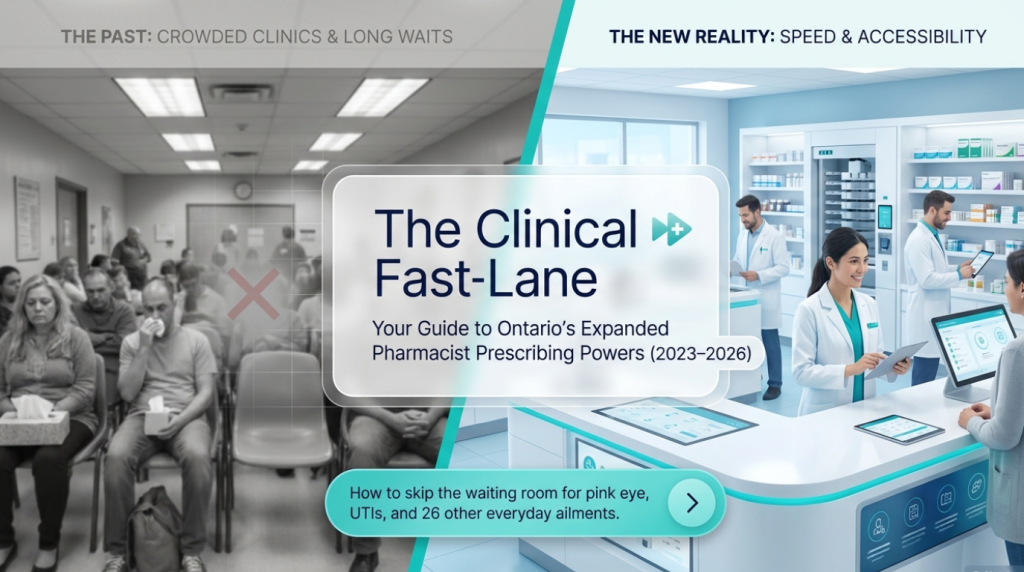
Waking up with a crusty, red eye. A burning sensation every time you use the washroom. A bug bite that’s turned angry and swollen overnight. A few years ago, every one of those situations meant the same frustrating routine: try to get a same-day doctor’s appointment, or spend half your day at a walk-in clinic, just to walk out with a five-minute prescription.
That routine is largely gone. Since January 2023, Ontario pharmacists have been legally authorized to assess and prescribe medication for a defined list of minor ailments – including pink eye (conjunctivitis), uncomplicated urinary tract infections, and insect bites – without a doctor’s referral. And as of July 1, 2026, that list just got bigger, adding nine more conditions, from dry eye to nasal congestion to head lice.
If you live in Markland Wood or anywhere in Etobicoke and you’ve been driving to a walk-in clinic out of habit, this guide walks through exactly what your pharmacist in Markland Wood can now treat, what to expect from the appointment, what it costs, and when you should still see a doctor instead.
What Changed for Ontario Pharmacists, and When?
Ontario expanded pharmacists’ scope of practice in stages. The first wave took effect January 1, 2023, authorizing pharmacists to assess and prescribe for 13 minor ailments. That list grew to 19 conditions by October 2023. Then, effective July 1, 2026, the Ontario government authorized pharmacists to assess and prescribe for nine additional minor ailments, bringing the total to 28 conditions pharmacists can now treat directly – without requiring a doctor’s visit first.
The legal basis for this sits in Schedule 4 of Ontario Regulation 256/24 under the Pharmacy Act, 1991, which sets out both the approved conditions and the specific medications pharmacists are permitted to prescribe for each one.
Can My Pharmacist Really Treat Pink Eye?
Yes. Conjunctivitis – commonly known as pink eye – has been on the approved minor ailments list since the original 2023 rollout, and it covers all three common types: bacterial, allergic, and viral conjunctivitis. Because these three types can look similar but require different treatment approaches (or, in the case of viral conjunctivitis, often no antibiotic at all), the pharmacist’s assessment focuses on distinguishing between them based on your symptoms, how long you’ve had them, and whether one or both eyes are affected. If a prescription antibiotic or antihistamine eye drop is appropriate, your pharmacist can prescribe and dispense it on the spot.
Can a Pharmacist Prescribe Antibiotics for a UTI?
Yes, for uncomplicated urinary tract infections. This has consistently been one of the most-used minor ailment services since the program launched, largely because UTI symptoms are distinctive and the condition is well suited to pharmacist assessment: no complex lab work is typically required, and the standard antibiotic options (drugs like nitrofurantoin, fosfomycin, or sulfamethoxazole/trimethoprim) are already familiar territory for pharmacists.
The word “uncomplicated” matters here. Pharmacists are trained to screen out cases that fall outside their scope – for example, UTI symptoms in pregnancy, in men, in someone with recurrent infections, or alongside signs suggesting the infection may have spread to the kidneys (fever, back pain, nausea). Those situations get referred onward rather than treated at the pharmacy counter.
Can a Pharmacist Treat an Insect Bite or Sting?
Yes. Insect bites and urticaria (hives) have been part of the minor ailments list since 2023, and tick bites are covered separately under their own category: post-exposure antibiotic prophylaxis to prevent Lyme disease following a high-risk tick bite. That second one is particularly useful for anyone who spends time outdoors in Ontario’s warmer months – instead of waiting to see whether symptoms develop, a pharmacist can assess the bite and, where appropriate, prescribe preventive antibiotics within the window where they’re effective.
For a standard bite or sting causing localized swelling, itching, or a hive-like reaction, the pharmacist can prescribe topical corticosteroids or antihistamines as needed.
What Is a “Minor Ailment,” Exactly?
The Ontario College of Pharmacists defines minor ailments as health conditions that can be managed with minimal treatment and/or self-care strategies. To qualify for pharmacist prescribing, a condition generally needs to meet several criteria:
- It’s usually short-term in nature
- Lab results aren’t typically required to diagnose it
- There’s a low risk that treating it will mask a more serious underlying condition
- Medication and medical history alone can reliably rule out more serious causes
- Only minimal or short-term follow-up is needed
These criteria are exactly why conditions like pink eye, uncomplicated UTIs, and insect bites made the list early – they’re common, recognizable, and rarely require imaging or bloodwork to manage safely.
What Is the Full List of Conditions Ontario Pharmacists Can Now Treat?
As of July 2026, the complete list of 28 minor ailments includes:
Original 19 (since 2023):
- Acne (mild)
- Allergic rhinitis
- Candidal stomatitis (oral thrush)
- Conjunctivitis – bacterial, allergic, and viral (pink eye)
- Dermatitis – atopic/eczema, allergic, and contact
- Diaper dermatitis
- Dysmenorrhea (menstrual cramps)
- Gastroesophageal reflux disease (GERD)
- Hemorrhoids
- Herpes labialis (cold sores)
- Impetigo
- Insect bites and urticaria (hives)
- Tick bites, post-exposure prophylaxis to prevent Lyme disease
- Musculoskeletal sprains and strains
- Nausea and vomiting of pregnancy
- Oral aphthae (canker sores)
- Pinworms and threadworms
- Urinary tract infections (uncomplicated)
- Vulvovaginal candidiasis (yeast infection)
New as of July 1, 2026:
- Calluses and corns
- Mild headache (tension-type)
- Pediculosis (head lice)
- Seborrheic dermatitis (dandruff)
- Tinea corporis (ringworm)
- Tinea cruris (jock itch)
- Verrucae (warts, excluding face and genitals)
- Viral rhinitis, rhinosinusitis (nasal congestion)
- Xerophthalmia (dry eye disease)
You can read all our specialised service here.
What’s New as of July 2026, and Why Does It Matter?
The July 2026 expansion is significant less for any single condition and more for the pattern it represents: pharmacists are increasingly becoming a genuine first point of contact for everyday health issues, not just a place to fill a prescription someone else wrote. Conditions like nasal congestion, dandruff, and mild tension headaches are exactly the kind of thing people used to either self-treat with guesswork at the drugstore aisle or, at the other extreme, book an unnecessary doctor’s appointment for. Now there’s a middle option: a proper clinical assessment from a pharmacist, on the same day, usually without an appointment.
The Ontario government has also indicated it plans to add roughly five more conditions to the list in early 2027, so this scope is likely to keep expanding.
How Much Does a Minor Ailment Assessment Cost?
If you have a valid Ontario health card (OHIP) or an Ontario Drug Benefit (ODB) eligibility number, the assessment itself is billed directly to the Ministry of Health and costs you nothing – pharmacies are reimbursed roughly $19 for an in-person assessment regardless of whether a prescription is ultimately issued. If you don’t have an Ontario health number, or you’ve already reached the annual claim maximum for that specific ailment, the assessment may become a private-pay service, with the pharmacy setting its own fee.
Importantly, the assessment fee and the medication cost are two separate things. The consultation may be free, but the prescribed medication itself is billed the same way any other prescription would be – through your private insurance, the Ontario Drug Benefit if you’re eligible (for example, if you’re under 25, over 65, or receiving social assistance), or out of pocket.
What Happens During a Pharmacist Assessment?
A minor ailment assessment is a structured clinical conversation, not a quick chat at the counter. Expect your pharmacist to ask about:
- How long you’ve had the symptoms and how they started
- Whether you’ve had this condition before, and how it was treated
- Any other medical conditions you have
- All medications and supplements you’re currently taking
- Any allergies, particularly to antibiotics or other relevant drug classes
- Whether any “red flag” symptoms are present that would point to something more serious
Based on that assessment, your pharmacist may recommend a non-prescription treatment, issue a prescription on the spot, or – if your symptoms fall outside the minor ailments criteria – advise you to see a family doctor or visit an urgent care setting instead. An assessment doesn’t automatically mean you’ll walk away with a prescription; sometimes the right answer is reassurance and a recommended over-the-counter product.
When Should You Skip the Pharmacy and See a Doctor Instead?
Pharmacist prescribing is designed for straightforward, low-risk presentations – it isn’t meant to replace a doctor for anything more complex. You should seek care from a physician, urgent care clinic, or emergency department rather than a minor ailments assessment if:
- Your UTI symptoms include fever, chills, or flank/back pain (possible kidney involvement)
- You’re pregnant and developing UTI symptoms
- Your eye symptoms include vision changes, significant pain, or light sensitivity (not just redness and discharge)
- A bite or sting is causing facial swelling, difficulty breathing, or signs of a severe allergic reaction – this is a medical emergency
- Symptoms keep recurring, aren’t improving with treatment, or involve a condition not on the approved list
- You’re unsure whether your situation counts as “minor” – your pharmacist can help you figure that out, and refer you onward if needed
How Do You Book a Minor Ailment Assessment at Markland Wood Pharmacy?
You generally don’t need to book weeks in advance for a minor ailment assessment the way you would for, say, a specialist referral. Call ahead to confirm same-day availability, or simply visit in person – pharmacies typically have a private consultation area for these conversations. Bring your Ontario health card if you have one, and be ready to describe your symptoms and current medications.
- Phone: 416-621-2000
- Address: Markland Woods Plaza, 4335 Bloor Street West, Etobicoke, Toronto
- Hours: Monday–Friday 9:00 AM–7:00 PM, Saturday 9:00 AM–4:00 PM, Sunday 12:00 PM–4:00 PM
Frequently Asked Questions
1. Can a pharmacist in Ontario prescribe antibiotics for pink eye? Yes, for bacterial conjunctivitis specifically. The pharmacist’s assessment first determines whether your pink eye is bacterial, viral, or allergic, since only bacterial conjunctivitis typically requires an antibiotic.
2. Can I get UTI antibiotics from a pharmacist without seeing a doctor? Yes, for uncomplicated urinary tract infections in eligible patients. More complex cases – including UTIs during pregnancy, in men, or with signs of kidney involvement – are referred to a physician.
3. Does a pharmacist need to see the insect bite in person to prescribe treatment? Typically yes, an in-person assessment allows the pharmacist to properly evaluate the bite, rule out signs of a more serious reaction, and determine the right treatment.
4. How many minor ailments can Ontario pharmacists treat as of 2026? 28 conditions, following the addition of nine more minor ailments effective July 1, 2026, on top of the original 19 approved since 2023.
5. Is a minor ailment assessment free in Ontario? It’s free if you have a valid Ontario health card or ODB eligibility number, since the assessment is billed directly to the Ministry of Health. Without an Ontario health number, the pharmacy may charge a private fee.
6. Does OHIP cover the cost of the prescribed medication? No. OHIP covers the assessment itself, not the medication. The prescription is billed like any other – through private insurance, the Ontario Drug Benefit if you qualify, or out of pocket.
7. What are the new minor ailments added in July 2026? Calluses and corns, mild tension-type headache, head lice, dandruff (seborrheic dermatitis), ringworm, jock itch, warts (excluding face and genitals), nasal congestion, and dry eye disease.
8. Can a pharmacist prescribe for tick bites to prevent Lyme disease? Yes. Following a high-risk tick bite, a pharmacist can assess the bite and prescribe preventive antibiotics if appropriate, within the effective treatment window.
9. Do I need an appointment for a minor ailment assessment? Many pharmacies, including walk-in visits, can accommodate same-day minor ailment assessments, though calling ahead helps confirm availability and minimize wait time.
10. What happens if my condition isn’t on the minor ailments list? Your pharmacist will advise you to see a family doctor, walk-in clinic, or, if needed, an urgent care or emergency setting – the assessment itself is designed to catch cases that fall outside safe pharmacist prescribing.
11. Can pharmacists treat minor ailments for children? Eligibility can vary by specific condition and age, so it’s best to confirm directly with the pharmacist whether a particular minor ailment service applies to your child’s situation.
12. Where can I get a minor ailment assessment near Etobicoke? Markland Wood Pharmacy offers minor ailment assessments at 4335 Bloor Street West, Etobicoke. Call 416-621-2000 or visit in person to check same-day availability.